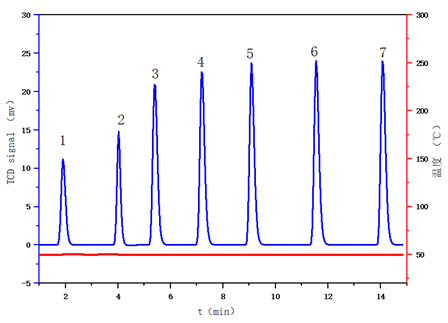

In the field of catalytic science and technology, the acidity and alkalinity, metal dispersion, specific surface area, number of active centers, and active sites of catalysts are key factors determining their performance. Among them, NH3-TPD (ammonia programmed temperature desorption) testing is a commonly used method for studying the distribution and strength of acidic sites in catalysts.
NH3-TPD testing is a method of studying the distribution, sites, and strength of catalyst acidic sites through programmed temperature desorption technology. The basic principle is to use ammonia gas (NH3) as a probe molecule to adsorb on the acidic sites on the catalyst surface, and then desorb the adsorbed ammonia gas through programmed heating. By detecting the position and area of the desorption peak, the strength and quantity of the acidic sites on the catalyst can be analyzed.
1. Sample Pretreatment: Heat the sample to a specific temperature (depending on the sample) at a heating rate of 10 ℃/min in a high-purity argon (Ar) atmosphere for 1 hour to remove impurities from the sample surface. Then cool down to the desired adsorption temperature.
2. During the Adsorption Process, switch to high-purity ammonia gas (NH3) and perform adsorption at the set temperature until adsorption saturation. This process ensures that ammonia is fully adsorbed on the acidic sites on the catalyst surface.
3. During the Blowing Process, raise the temperature to 100 ℃ in an inert gas (such as argon) atmosphere to remove the physical adsorption of NH3 on the sample surface. Once the baseline is stable, the detachment experiment can begin.
4. Temperature Programmed Desorption (TPD), set the heating rate, heat up to a specific temperature, and record the desorption peak. By analyzing the position and area of the desorption peak, the strength and quantity of the acidic sites of the catalyst can be obtained.
5. Data Analysis: The PCA-1200/PCA-2200 chemical adsorption instrument is equipped with intelligent software that can automatically calculate the acidity and alkalinity of the catalyst, providing detailed data on the distribution and strength of acidic sites.
In the actual testing process, some common problems may be encountered. Here are the solutions:
1. The peak shape is inverted, and the PCA-1200 software settings allow users to choose between inverted/positive peak modes. This setting has no substantial impact on the test results and users can adjust it according to their needs.
2. The appearance of impurity peaks may be due to gas impurities, catalyst decomposition, template agent desorption, and other reasons. It is recommended to use high-purity gas with a purity of 99.999% to avoid interference from impurities.
3. No peak is observed. If no peak is observed, it is usually due to low detector sensitivity or insufficient acidity of the sample itself. Increasing the sample loading can improve the PCA-1200 by using a self-developed chemical adsorption instrument dedicated detector, which can effectively avoid problems caused by insufficient instrument sensitivity.
4. The peaks cannot be separated. If two adjacent peaks cannot be completely separated, it may be due to the similar intensity of the active center in the sample itself, too fast heating rate, or too much sample size. Suggest reducing the heating rate or sample size appropriately to improve peak separation efficiency.
The Beijing Builder PCA-1200 fully automatic chemical adsorption instrument has become a powerful tool for catalyst characterization due to its high sensitivity, multifunctionality, and automated operation. Whether used for laboratory research or industrial applications, PCA-1200 can provide reliable and efficient data support.
contact
Be the first to know about our new product launches, latest blog posts and more.Any question or request?
Click below, we’ll be happy to assist. contact