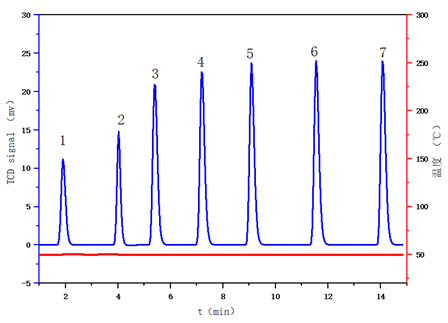

Metal dispersion is the percentage of metal atoms with catalytic activity to the total number of loaded metal atoms, reflecting the selectivity and activity of the catalyst. Generally, the better the dispersion, the better the catalytic effect. When the dispersion is equal to 1, it indicates that all metal atoms are exposed to participate in the reaction.
The method for determining metal dispersion usually relies on chemical adsorption, using the Builder-PCA1200 chemical adsorption analyzer. It utilizes the selective chemical adsorption of certain gases (such as H ₂, O ₂, CO, etc.) on specific metals (such as Pt, Pd, Rh), and the adsorption amount of these gases has a clear stoichiometric relationship with the metal, from which the dispersion of the metal can be calculated.
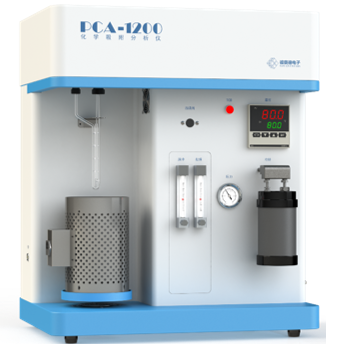
There are three common types of metal dispersion tests, which are conducted using the Builder-PCA1200 chemical adsorption instrument. Before testing, the sample should undergo sufficient pre-treatment.
1. Carbon monoxide (CO) pulse titration method: suitable for various metal supported catalysts, such as Mn, Fe, Cu, etc. Before pulse titration, the sample needs to be pre treated with inert gas flow blowing. Then, multiple pulse titration experiments are conducted using a quantitative loop at a constant adsorption temperature. If no peak appears on the software, it represents complete consumption. If a peak appears, it represents the amount of CO that did not participate in the reaction. When the peak area remains unchanged, it represents the end of the reaction. Obtain data such as CO adsorption capacity through software to calculate metal dispersion.
2. Hydrogen (H ₂) pulse titration method: The principle is basically the same as CO pulse titration, but Ar is usually selected as the carrier gas. However, for noble metal supported catalysts, due to the possibility of "hydrogen overflow phenomenon" leading to quantitative result errors, in some cases, oxygen is first used to oxidize the noble metal loaded on the surface, and then hydrogen is used for titration (hydrogen oxygen titration) to avoid direct reaction between hydrogen and noble metal and reduce testing errors.
3. Nitrous oxide (N ₂ O) pulse titration method: using the oxidation reaction between metal and N ₂ O on the surface to determine the dispersion of metal, suitable for metal supported catalysts that do not adsorb probe molecules such as CO and H ₂. This method can be used for most easily oxidizable metals. The key to this method is to separate N ₂ and N ₂ O from the reaction products. Common separation methods include liquefying N ₂ O with liquid argon cold trap using boiling point difference, removing N ₂ O by filling the cold trap with alkaline molecular sieve, separating N ₂ O by using chromatographic column with different gas flow rates, or quantitatively analyzing N ₂ O by connecting mass spectra with different mass to charge ratios.
contact
Be the first to know about our new product launches, latest blog posts and more.Any question or request?
Click below, we’ll be happy to assist. contact