
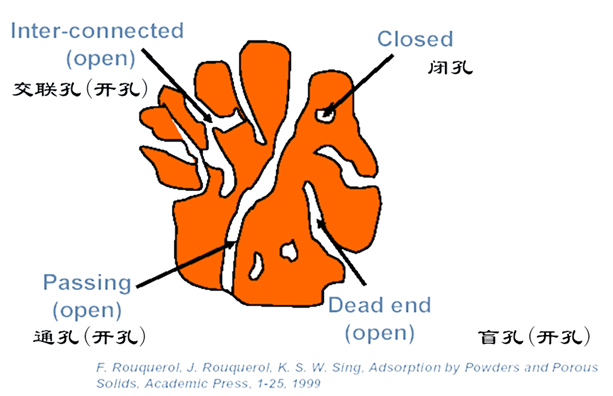
The pores, channels, or cavities within a solid, as well as the solid particle space between the bed, compacts, and aggregates, can all be considered as pores.
The cavities and channels connected to the external connection are called openings and can be analyzed by gas adsorption method. In addition, there are also some pores in the solid that are not connected to the outer surface and cannot penetrate the fluid, which are called closed pores because they cannot be connected to the outside world and are not within the measurement range of gas adsorption or mercury intrusion methods.
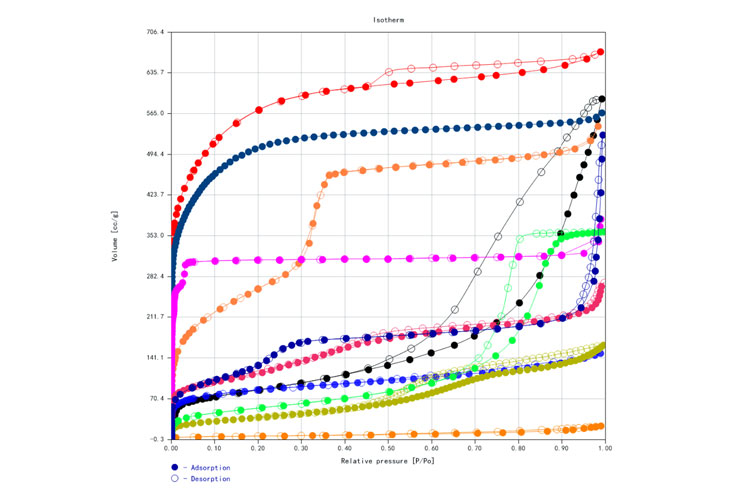
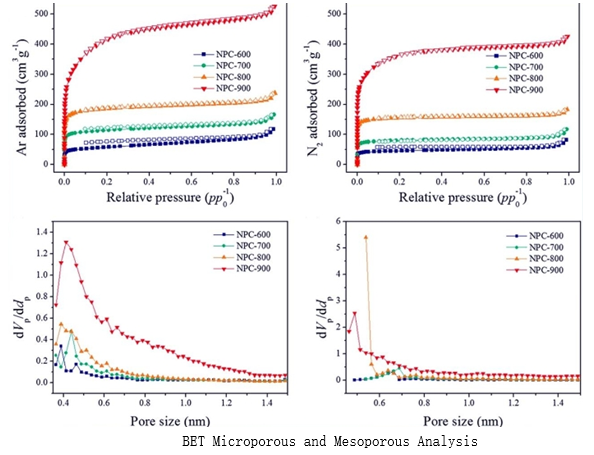
The size of the open pores can be characterized by physical adsorption method. According to the size of the pores, there are usually gas adsorption method and mercury intrusion method for testing. However, both methods have testing limitations, that is, they can only analyze pore sizes within a certain range. The typical gas adsorption method (physical adsorption instrument or specific surface area and pore size analyzer) has a testing range of 0.35-300nm (upper limit of 500nm), while the mercury intrusion method usually analyzes larger pore sizes, with an analysis range of 5nm-500 μ m. For materials with larger hole sizes and spans, it is usually necessary to use both analytical methods simultaneously.
The SSA4000 and SSA7000 physical adsorption analyzers (BET specific surface area and pore size analyzer) can be applied to analyze the specific surface area and pore structure of porous materials. By utilizing the adsorption characteristics of solid materials and using gas molecules to measure the specific surface area and pore structure, the testing range is to detect micropores (0.35-2nm), mesopores (2-50nm), and macropore size distribution (50-500). It can also be used for single component gas adsorption capacity analysis, equivalent adsorption thermal analysis, and selective separation analysis of gases such as ethane/propane/ethylene/methane/carbon dioxide.
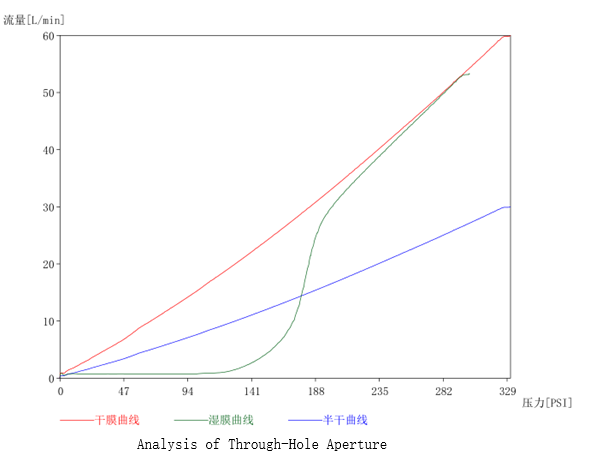
The size of through-hole usually requires the use of gas-liquid or liquid-liquid pore size analyzers. The MPS1100 pore size analyzer is suitable for analyzing 0.013-500 μ m pore materials, such as filter membranes, battery separators, filter cartridges, and other filtering materials.
contact
Be the first to know about our new product launches, latest blog posts and more.Any question or request?
Click below, we’ll be happy to assist. contact